Google
Showing posts with label all. Show all posts

Saturday, November 15, 2008

SEO is more about Content


The rich Internet application (RIA) technology they employ, however powerful, makes these Web applications a black box to search engines. However, that is okay because you probably don't want your taxes or e-mail indexed! Search engine optimization (SEO) for these technologies is more about the content they wrap around rather than the actual Web application itself. Here's some specifics:

Landing page: A simple HTML/CSS landing page is essential for these Web applications, as this is where you'll want the search engines to steer all your branded query traffic. It should load super quickly and provide direct links to all of your other indexable content, such as your blog and help content.

Blog, sales content, and conversion tracking: Just because you've got the coolest Web application in the world doesn't mean that it couldn't benefit by some great content as well. As they say, content is king. In this spirit, having a blog and a set of high quality sales and informational content can help draw a lot of links and attention to your site. Just make sure you're properly instrumenting your site and all the places you're driving traffic from so that you can track your conversions and optimize these pages accordingly.

Help content: Don't forget your help content. Users should be finding help on your site, not on third party sites that may be giving questionable guidance. Ensure your content is accessible to search engines, well linked, and included in a sitemap. (Link to it from specific articles in your blog too, when appropriate!)

Content Web Applications

I'm sure you've seen these sites (though probably not found them via search). These are sites that have a lot of content search engines would love to index and customers would love to find, but unfortunately they are locked behind a Web application that is impenetrable to search. Hidden in a veritable lock box. Examples include: Live Search Help Content, Adobe Max Conference, Arbor Snowboards, and Swatch. Many times these sites are sold as the best of both worlds, and at first glance that is what they look like. But the more you use them, the more you realize how impractical they are for both searchers and users.

Here’s a few strategies for how to optimize these types of sites:

Refactor content and functionality: Figure out which components of your website are content, and which are functionality. For an example of this, take a look at the Mix Conference website vs. Hulu's website:

image
image

In each of these screenshots, the RIA portion of the site is highlighted in red. Both of these sites present a gallery of videos for their customers to see. But in the Mix website on the left, they have packaged both the content and the functionality (such as navigation, commenting, viewing) into a single RIA. Contrast that to the Hulu implementation on the right, where they have built the navigation of the site out in HTML, and use the RIA components on each page for specific functionality, including video playback and related video recommendations. This method allows search engines to crawl and index all the content on the site, and also allows users to easily bookmark and share content they like.

Down-level experience: A down-level experience for RIA components should be provided whenever it is appropriate so the content is also accessible to search engines, Smartphone Web browsers (more than 100M!), and people with screen readers. For more information on developing a down-level browser experience, see this PowerPoint presentation from Jane and Robot.

Sitemap: You should also consider providing an XML sitemap of all your content for use by search engines, and also an HTML browse experience for your customers as well. For more information on sitemaps, see this post on the Live Search blog.

Content Website

Also known as just a normal website. Using RIAs can also be a great idea.However, you’ll want to ensure that you use all the same best practices as outlined above. Examples of this include Wikipedia, Digg, TechNet and MSDN. Best practices for optimizing these types of sites have been well covered in another post on the Live Search Webmaster blog.

At the end of the day, it doesn't matter what technology stack you use to create your website. You just need to make sure that your implementation decisions reflect the goals of your website and you are getting the best ROI from search acquisition.

-- Nathan Buggia, Live Search Webmaster Team

Friday, November 14, 2008

SEO is Like a Box of Chocolates


by nick

The fact that natural search engine rankings are curiously unpredictable things is just something that comes with the territory of search engine optimization. SEO professionals are set with the task of managing and adapting to the every day fluctuations of the industry.

box of chocolate by aunt owwee on flickrThese changes can come in a variety of ways. Search terms that are doing well one month could suddenly decline in the next due to seasonal preferences, product innovations, a change in search vernacular or something completely unforeseen. New businesses selling similar products are springing up all the time, which can lead to increased competition for your chosen keywords. And don't forget the fact that every search engine out there seems to be in the midst of continually upgrading the way their search algorithms perform and produce results. Granted, this is great for searchers, but it does have a way of making SEO interesting.

Adaptation

So how do you contend with an ever-changing industry? You evolve with it. I know it sounds like a simple solution that everyone should already understand, but that's not always the case. I'm sure there are still people so engrained in their personal tried and tested optimization strategies that when search positions start slipping, all they can do is scratch their heads as to the reason. The factors influencing search results are too numerous to count, but staying alert to as many of those changes as possible is a prosperous way of maintaining SEO.

That's not to say that every new idea for influencing search results is always a good one. A strategy considered to be completely SEO-tastic one day can easily be shucked aside for something thought to be better the next. Take the time to research and test new search innovations. Be sure the impact of these new strategies won't fade away before you can even implement them.

Use What You Know Works

There isn't a single (legitimate) solution out there that will thrust your site to the top of search results. It doesn't exist. What does exist are a variety of ideas and strategies that, when used in conjunction with each other, can help boost the visibility of your site on SERPs. I suppose the moral of the story here is that to increase your search positions, use a combination of valid solutions that you know work.

Of course you always want to keep usability in mind when optimizing, but why not cover all your bases?

As stated before, SEO is an evolving process. Implementing a strategy that intelligently utilizes as many aspects of search optimization as possible is the only way to know you've done all you can to adapt to the unpredictable nature of search engines.

Microsoft Eyes on Online Marketing, Email and Social Networking


By Rich Cherecwich

As web portals like Yahoo and AOL try to open up to the rest of the web by incorporating content from third-party websites, Microsoft has taken a bold step in the same direction by redefining its Windows Live software and websites as a social network.

The software giant re-launched several of its Live websites on Wednesday, combining its popular email and instant messaging services with other web applications.

Just like a standard social network, users can now build their own profile pages, but Microsoft also lets users incorporate content they've made on other websites, including Flickr, LinkedIn, Pandora, Photobucket, Twitter, WordPress and Yelp.

"Our customers have friends across the web," said Chris Jones, VP of Windows Live Experience Program Management in a press release. "They communicate through many unconnected web services and want access to it all from a single location -- without worrying about how it's done."

Windows Live users are automatically logged on to the Windows Live Messenger IM client to communicate with friends. Other services include an online movie making program and a "groups" service that lets users share photos and documents and chat with each other online.

The new Windows Live also includes several elements that come straight from the most popular social networks, including the "what's new feed," a feature very similar to Facebook's newsfeed.

While AOL and Yahoo have both been moving toward a more open and social internet, Microsoft has seemingly passed both of them by. It also puts Microsoft in position to wrestle away advertising dollars from its biggest rival, Google, which also offers email, chat and document sharing services.

Using Tools to Find Keyword rich Domain Names


This is a really simple guide how to register keyword rich domain names getting organic traffic. Find and register keyword rich domain names to use for landing pages, link building or 301 redirects.

There are two tools we will use here; the Google AdWords keyword tool and a bulk whois checker. Google AdWords keyword tool is a great tool in many ways. We will use it here for finding domain names with keywords people search for.

This is how you do it.
•    Go to Google AdWords keyword tool, https://AdWords.google.com/selec/KeywordToolExternal
•    Pick the keyword or keywords which you are interested in. I will pick the keyword "laptops". This keyword is quite competitive and probably isn't the best example but I am pretty sure Google will provide us with a couple of domain name ideas containing the keyword "Laptops".
•    Make sure that the "use synonyms" box is ticked. We want Google to give us synonyms on our keyword(s). Then hit "Get keyword ideas".
•    Filter the results on Exact matches (Broad is fine too but exact is.... Exact) adwords.jpg
•    Scroll down and click on "download all keywords" and choose text format as the output. Or you can manually add each and every keyword. But I prefer to go with the bulk approach.
•    Copy and paste the keyword list into a blank word or notepad document. Then use the find and replace function to remove the [ & ] characters.

word.jpg

•    Now you got your list of keywords, keywords containing "laptop" and keywords people search for on Google.
•    Next step is to go to a bulk whois tool, the whois will tell us which domain names are available and which domain names are already registered and who owns them.
•    Moniker bulk whois is one of the best ones, lets you search for 500 domain names at once (however nowadays it requires you to register but registering is an easy thing). Head over to http://www.moniker.com/domains/batch_reg.jsp. There are other bulk whois tools as well, http://www.domaintools.com/bulk-check is another ok one.
moniker.jpg

•    Copy the list of up to 500 keywords (now without the [ & ] characters) and don't worry about adding a .com, .co.uk extension into the search box and hit search. Before you hit Search you can filter on preferred domain name extension, if you only want .com and or co.uk etc. Hit Search.
•    Whois will tell you which domain names are available to register. Our keyword "laptops" don't give us that many available domain names to choose from. But there are a few available ones (at the moment of writing that is).
moniker2.jpg
•    Of the available domain names we found, mostpopularlaptop.com "most powerful laptop" gets 1000 exact searches on Google every month and bestbudgetlaptop.com "best budget laptop" gets 590 exact searches on Google every month.
adwords_printscreen.jpg
•    That's it really. Play around with your keywords and when you find your gem(s) then head over to your preferred domain name registry and register your new domain name!

Thursday, November 13, 2008

OpenCart - One of the Best Free Opensource shopping cart site


According its website, OpenCart is an open source PHP-based online shopping cart system. A robust e-commerce solution for Internet merchants with the ability to create their own online business and participate in e-commerce at a minimal cost.

OpenCart is designed feature rich, easy to use, search engine friendly and with a visually appealing interface.

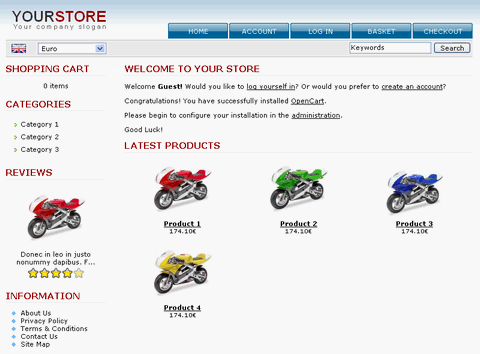
Here is the admin interface and store front.
opencart admin

opencart store front

Requirements: Apache, PHP 5+ and MySQL
Demo: OpenCart - Demonstration
(Username: demo / Password: demo)
License: GPL License
 

Things you should know:

  1. The demo of this system is a default installation.
  2. Some admin features may have been disabled for security reasons.
  3. The entire system is deleted and reinstalled every two hours.
We encourage you to take advantage of opensourceCMS and be the administrator of this software system. Add, create, delete, and manipulate this system all you want as the system is automatically deleted and reinstalled every two hours.

10 Methods to Build Link Popularity


Link Popularity is one of the most important factors affecting your Search Engine rankings. When your site is popular with other web-sites, the Search Engines love you, but if you are the new kid on the block, they ignore you - totally. It's great to be popular and improving your Link Popularity will also get you higher rankings on the search engines.

Here are a few ways you can grow your inbound links.

1) Articles: Almost anybody can write articles. This is the easiest way to get started on your way to Search Engine manna. It's just a question of putting down your thoughts in a coherent manner. As long as the information you are providing is useful and valid, your articles will be sought after by publishers out there. There are also hundreds of article directories on the net.

2) Blogs: Blogs are not as easy to do as Articles are. But they are a very useful tool, nevertheless. When you have a blog, you have an audience. It's like a fan base. They have certain expectations of you. They want you to churn out hit singles or albums. But they want you to give them more. Even though they started out as mere diaries or daily jottings of a few people, currently they are excellent link building, content management and search engine optimization tools.

3) Free Products: The easiest way to do this is to write a tool and provide it for download. Or maybe even provide a service for free. The greatest example of building a business with free service that comes to mind is hotmail.com. Once your service becomes a must-have, it's only a matter of time before you can start making money from it. Also you can have people point to your site to give their customers access to your tool.

4) Allow People To Link: Always create a page on your website that will enable people interested in your website to link it with their website. Alternatively, request website owners you are familiar with or the same industry, to add a link to your website preferably with a catchy description of a few lines.

5) Trackbacks: This is the easiest way to get your links out there. What you do is go to other blogs (Authority Sites) in your industry and become a regular contributor. Or comment on the blogs. Along with your signature, most people provide a link to your web-site. And the more links you have pointing back to you, the more popular you get. Also, when you become a major contributor/commentor, people start valuing your opinion more.

6) Syndication: You can offer your articles to other sites for publishing for free or for payment. Your article links back to your site.

7) Reciprocal links: You provide a link to another peer site, in return for them linking back to you. This is a good way to get your target industry users to come to your site. Also you introduce your users to other sites that they may be interested in visiting. They will be thankful to you for pointing them in the right direction. And they come to trust you more.

8) Partner links: Your local Chamber of commerce, Suppliers, Resellers, Affiliates, Sites selling complementary products etc.

9) Links from Forum Signatures: These do not carry as much weight in terms of SEO as one might think. Yes, they are one-way links, and yes, they can be from pages that have content relevant to your site. But that doesn't mean much unless your links appear in a forum's thread that is popular enough to be linked to from static web pages, or the thread's URL doesn't contain many random characters (historically they have been harder for search engines to index). Most pages at a forum are only linked to from one other page: the main category of the topic. Getting links on pages with little to no link popularity themselves won't help your site much.

10) Directory Submissions: Directories can provide you with a one-way link on pages with highly relevant text. Some directories, like the Yahoo! Directory are weighted very heavily by other search engines. A link from these directories can be the most valuable link your site can receive. While there are thousands of free directories on the web today, paying for the more prestigious listings will go extremely far in not only increasing your link popularity, but also establishing a level of legitimacy with the major search engines.

Be noticed:

1. No amount of link popularity will help you if don't have the content to keep visitors at your site. So start with good content.

2. Make sure that you are being linked to by Authority sites with a Good PageRank. Also the linking sites should somehow be relevant to your industry. If not, it only serves to confuse the Search Engines and your rankings will suffer.

3. Some forums even use a 'nofollow' tag on outbound links as a means to curb link spammers. By all means, if you are a regular participant at forums, mention your site in your signature for the purpose of creating awareness and click-through's from forum readers, but not solely for link popularity purposes.

What Social Media Marketing worths?

Traffic to websites only becomes an asset when it translates into something,such as becoming a bookmark, a sign-up, a link, or helps establish a genuine relationship. It must also result in an increase in revenue. If it doesn't, then traffic remains an expense.

Most of the people on social networks aren't interested in commercial messages. Thus traffic from social media marketing isn't priced higher, because it isn't translating into revenue for the advertisers. This isn't happening because the intent of the users when engaged with social media campaign is not conducive to selling stuff.

There indeed are some niches that do just fine with social media marketing traffic, but they would pretty much have to be targeted to time wasters and that age group for it to really work.

One solution is using it as a link building strategy, an effective technique if your content is linkworthy, unfortunately many sites that get exposure don't get many links out of it. Links and exposure can be generated through social media marketing, but it has to be done right, and if your bottom line relies on sales conversions from that traffic, then that really isn't where you should be spending your efforts.

For instance, there is a case that a company came off of doing a digg campaign that resulted in over 45,000 visitors. All garbage visits of course but they resulted in links which translated to a 30 place jump in Google. That's a very tangible and measurable result.

If you look at social media marketing like Digg for conversion, It will never work. But if it's used correctly, it can be leveraged for successful monetization in a round about way. It's not "brand spend", it's a way to expose people to a page and have them give you a link. Dollar for dollar, it can be the most cost effective way to build links and should be looked at as just one part of an overall campaign. Ignoring it because it's hard or because it doesn't work the first couple of times is not a great way to approach it.

In summary, traffic from social media marketing is not traditional traffic as before, thus it should be carefully viewed and used.

Wednesday, November 12, 2008

A Template of seo/sem Quotes of Service

Executive Summary:

Background: Key SEO / SEM Campaigns to better enhance the effectiveness of customer website internet marketing】

Objectives:
The main objective: 【list of the main objectives of the campaign, as well as to measure the qualities of the implementation of standards】
Can make a full stop to optimize the overall Web site traffic to increase, maintain individual keywords

Secondary objectives: Key to sites as far as possible in a target population (the audience's behavioural analysics), in order to achieve greater awareness】

Analysis of the target Web site: http://www.google.com

The target countries and regions:

Analysis of the visitors:

Analysis of user behaviors:

Recommended search engines:
Google: Google paid keywords, Google's content network, as well as Google's Union Web site (AOL, Ask, HotBot, Iwon, Lycos, and Netscape)
Yahoo:
MSN:

【Analysis of the budget given】

Recommended Budget
【From the above analysis we can see that the budget for high-input-output ratio better than low-budget, brought about a more efficient flow. We recommend a minimum budget of XXXX dollars per month. 】

Implementation

Implementation of the campaign
And a summary of the pre-planned: one week to complete
2 approval of the text of writing and choice of location: the completion of week

Timetable for the implementation of the campaign
1 implementation, one month to three months
2 communication, bi-monthly
3, summing up the implementation of the program
4 implementation of the program to repeat

Implementation strategies
Keywords SEO Strategy
SEO onpage optimization
SEO offpage optimization
SEM Search Engine Marketing Strategy
Social Media Optimization
Target Audience Behavioral Analysis
Web Site Functionality Optimization
Competitor Tracking and Analysis

Goals
1. To the right place ranking 1-3
2. Quality of visitor traffic and growth
3. To enhance the conversion rate
4. To enhance the value of PageRank, search engine index, ALEXA ranking, and so on

Forecast:

Additional requirements

Attachment: seo's qualification

Tuesday, November 11, 2008

Seos for blogs on blogspot.com


The blog on Blogger.com is very Good content container that does very well with search engines especially with Google search engine, because Blogspot.com is a sister service provided by Google company. Here you go to SEO your Blogspot blog. There are some tips to optimize your free blog hosted at Blogspot.com:

1. The title of the blog. You must write the main keyword of your blog as the title of your blog. You can do that by going to Setting in the Dashboard from your Blogspot account.

2. The description. You should also write a descriptive paragraph about your blog in the description area in the setting area from your Blogspot account.

3. Edit the standard template to a more SEO friendly version - optimise the title and description field in the template.

4. Write daily. Search engines like updatable blogs with daily fresh content, you can write a post per day for that issue.

5. Get links to your blog: Build links from blog directories, ask people to link to you, syndicate your blog etc. This is the most important strategy for your blog, you should get high quality links to your blog from good websites.

6. Ping options. This service alert the internet users when you add more posts to your blog, just search for Blog pinging in the Google search engines.

7. Feed Burner. You should also register with Feedburner.com to add a subscription function for your visitors to keep them in touch with your knowledge.

In summary, if you want to use your blogspot presence as a website to earn money from google Adsense or to test things, you need to treat it exactly the same as a regular website.

Monday, November 10, 2008

Image search engine optimization


Image SEO is no doubt one of the cheapest ways to tap into popular culture.If your web graphics are optimized for Image search engines like Yahoo, Google or MSN, they can be a nice alternate source of traffic to your website. But unlike regular web search where we know how search engines rank content, the rules associated with Image search rankings are very different and often based on assumptions.

Here is a limited number of considered factors for image seo:

    * file name
    * image alt text tag
    * image title
    * text near the image
    * image age
    * click streams
    * trust of site image is on
    * links referencing the image

Hence, regarding image seo optimization, here are a few simple things that you should keep in mind for getting good rankings in Google Images Search:

» Use a descriptive image filename - If your webpage has pictures of Bill Gates house - use filenames like bill-gates-house-party.jpg instead of the default camera file name like IMG_401.jpg

» Attach a 7-8 description with both the ALT and TITLE attributes of the IMG tag - Make it a habit to use these attributes.

» A short two line description of the image just beneath the graphic is the best way to describe an image. It can work wonders for your image search rankings as well. For an live example, read any news story on the BBC website or see the screenshot on your right.

» If possible, try to wrap text around your images using float.

» If you site design won't allow wrapping text or if the image is large in size, try to place the images near text that describes the context of your image. If the image is of an Adobe Photoshop box, don't place that image near the paragraph that describes Corel Photopaint.

» Web Images placed at the top of the page are more likely to appear in search results than the ones which are at the bottom. I have no proof to explain this but it's just an observation.

» Web Photo Galleries which have no text descriptions can make use of the Title and Meta tags to insert information about the images.

» The HTML tags enclosing the image descriptions will also matter. A descriptions enclosed in H3 or Bold tag will have more weight than the one enclose in the Parapraph tag.
However,while good rankings in Image search engines can drive lot of new traffic, it can also shoot up your bandwidth bill as people may hotlink images hosted on your webserver. If hotlinking is your concern, look at some of free image hosting websites.

Godaddy vs. Google Apps for kicking-off


For those who would like to earn money online, the first question could be: using GoDaddy directly, or Google Apps for Your Domain and other services?

There seem to be pros and cons to both options: buying your domain name direct through GoDaddy, or through Google Apps.

Simplicity. For GoDaddy, it's not clear what you do or don't get as part of your domain name purchase, and what has to be selected and paid for as an extra. Though you could probably figure it out from the final page, or after the event! At least with Google Apps you know what you're getting, much more clearly: Gmail-type email, etc, for free. Which may be worth the (probably) slightly greater cost, if you're only buying a single domain.

Cost. One factor is of course cost. For a single domain name, GoDaddy seems to be cheaper, but if you add the private registration fee then there's little difference, at the moment anyway. However, GoDaddy often have a multiplicity of special offers, e.g. if you buy lots of domain names in bulk, there can be a discount. (You might want to buy up variations of your blog names as I have, e.g. in my case consumingexperience.com, aconsumingexperience.com, theconsumingexperience.com). The price can also vary depending on whether you're buying a year's registration, or more than 5 years' worth, etc. And you can get private domain registration if you buy direct from GoDaddy too.

A minus from a consumer/usability viewpoint is that GoDaddy's offers are hard to figure out, with some inconsistencies or contradictions on the site. In particular it's not at all clear whether and when you can combine several different types of offers on their website. I spent a happy few hours (not!) hitting the Back button, opening lots of browser windows, trying out different combos.

The moral is that you need to figure out exactly what package you want, then try different routes in to your desired package, from different parts of their website, and see if they make a difference to the final pricing and features.

    Tip: for non-US residents, you can choose to see the pricing in currencies other than US dollars, if you prefer. It's up to you whether you want the conversion to your local currency to be done by GoDaddy or your credit company, really.

Sunday, November 9, 2008

Eight best open source shopping cart solutions

  • Presta is robust, professional grade e-Commerce shopping cart that you can download, install, and use for free. In the back end, you will use a full featured back end to manage your inventory, orders, shipping, and customers in real time. Your customer’s payments are sent directly to your commercial bank account using the latest security technology. You can even add your own modules to the shopping cart.
  • OpenCart is an open source PHP based online shopping cart system. OpenCart is easy to use and is SEO optimized with a very nice interface. A great feature of OpenCart is that customers can write their own reviews of the products.
  • Magento is a professional open-source e-Commerce solution offering unprecedented flexibility and control. Magento is awesome, I would never believe it is an open-source project. It features clean urls and SEO from the start. Everything is designed in a clean and simple way. Magento also features: Unlimited flexibility, Completely Scalable Architecture, Professional and Community Support, and Smooth Integration with 3rd party apps.
  • CubeCart is very popular shopping cart. CubeCart V3 is free, with the exception that you leave their copyright notice in your footer. CubeCart has a large amount of payment gateways and shipping gateways. Their support forums are lively and many people contribute plugins to the cart. To use CubeCart V4 you must pay but it has many features that V3 doesn’t have.
  • AgoraCart is another very popular online shopping cart, written in Perl/MySQL. It features a css manager so you can edit the look of your cart online. AgoraCart also features unlimited product options, up to 4 different tax zones at the same time, tons of shipping and payment gateways/options. The setup options range from a simple template based store to the integration of a complex visual design and support for program modification.
  • Zen-Cart is a free, user friendly, open source shopping cart. Zen Cart focuses on the merchants and shoppers instead of the developers. Zen Cart also supports multiple payment and shipping options, quantity discounts and coupons. Also Zen Cart is very easy to install.
  • osCommerce is an online shopping cart that offers a wide range of features that allows online stores to be setup fairly quickly. osCommerce is backed by a great and active community. It also supports multiple currencies, allows customers to print invoices from the order screen, and has an easy database backup system.
  • StoreSprite is a powerful, free PHP/MySQL shopping cart system that is easy to install and customize.  The Cart is free but it does have copyright notices that you can pay to get rid of.  StoreSprite has many features including automatic tax calculation, automatic delivery cost calculations, customer ratings and reviews and featured products.

Saturday, November 8, 2008

Pros and Cons of SEO Spam

According to the definition from seologic.com, in the search engine world, spam is defined as the manipulation of a web page to give it an artificial boost in the search engine rankings. Generally, spam is what the search engines say it is. I.e., it is defined by the search engines themselves. Each of the major search engines provide specific guidelines describing what webmasters should and should not do to their web pages in order to achieve a better search engine ranking, though that has not always been the case.

Among all kinds of SEO spam, unlike other types of spam, good link spam carries with it a wealth of benefits for the site being spammed:
1. It brings users. When a new social site debuts, especially when it is a "me-too" site like Quamut, getting users is tough. Unless you offer some special incentive, or your site provides something necessary that other sites don't, you have to fight a tough battle for users. If someone wants to add link spam to your site, they need to sign up. The thousands of SEO Spammers out there can quickly become thousands of new members of your site. And when the spammers sign up under multiple accounts, they can quickly become tens of thousands of new members.

2. It adds content. It might not be the best content ever written, but SEO spammers do know how to write content that, at the very least, is unique, keyword-rich and geared to any user that might stumble upon it. Contrary to popular belief, SEO spammers are not interested just in backlinks, but also in filling up the SERPs. If they can get a page on your site to rank by combining their content with strength of your site, and then convincing the user to shift to their site, the bottom line stays the same.

3. It raises stature. When your brand spanking new social network has 10,000 members and 50,000 UGC articles after only one month, your site starts to get noticed--even if most of those members are spammers and that content is primarily spam. There's a reason companies like MySpace and YouTube didn't crack down on spammers--and even explicitly allowed spam in their original Terms of Service. If you want to grow--and grow fast--no one will help as much as spammers.

In normal opinion, SEO should be WHITE all the time. No spam. Even that word is a bad thing.Ironically, SEO Spammers are helping the internet continue to grow. As each once-spammed site gets big off of the shoulders of spammers, they introduce methods to lock the spammers out, and the spurned SEOs move on to new sites. The cycle continues--and, with it, innovation in the social and user-generated content fields.

Friday, November 7, 2008

Social Media Mesurement Related Posts

Posted by Barry Hurd

Social Media Measurement is a very complex and strategic process which is absolutely meaningless without an end objective or frame of reference to work with. In many business applications, such as corporate or enterprise brand campaigns: begin with educating yourself on the ideas around social media and open yourself to “thinking big” so that you can appropriately enter the marketplace.

To help decision makers in this educational process, I have collected a variety of presentations from the web that are the “best of the best” explanations. I do not agree with every single bullet point, as each one presents data from different projects and for different reasons, but they do a great job of opening your mindset to a great number of questions.

If you want to educate yourself with 15-20 minutes of reading with some different insight to social media measurement and analysis, I suggest you browse through the following presentations.

Social Media Measurement
View SlideShare presentation or Upload your own. (tags: poplabs ruger)
Social Media
View SlideShare presentation or Upload your own. (tags: evolution networking)
Measuring Social Media November 2007
View SlideShare presentation or Upload your own. (tags: pr media)

Federated Media Unveils Social Media Measurement Tools


By Douglas Quenqua

Ad network Federated Media Publishing is launching a new suite of tools to help marketers measure ad campaigns across social media.

The San Francisco-based network is partnering with a litany of big-name Web properties to collect the necessary data for its Conversational Marketing Toolbox program, including Google, Yahoo, Twitter, comScore and DoubleClick. The Toolbox will be officially unveiled at FM's 2008 Conversational Marketing Summit today in San Francisco.

The CM Toolbox allows marketers to follow a number of metrics unique to social media, in addition to standard measurements like click-through rates and impressions. Actions like Twitter mentions, blog posts and comments, widget adoption and social bookmarking are tracked and scored, giving marketers a comprehensive snapshot of brand activity.

"When and where is your brand being Tweeted, and how many times? What blogs are mentioning it, and what do the comments look like? How many friends are you getting on Facebook? The CM Toolbox rolls all that up into a customized set of data points that marketers can review and see how their campaign is going," said Matthew DiPietro, marketing manager for FM.

DiPietro stressed that the measurement system will be customized for each client to reflect the specific media they wish to follow.

The toolbox is launching in beta mode with a handful of FM's largest clients on board, including Intel, Best Buy, and American Express. DiPietro said FM expects the offering to be available to all FM clients as a "value-added service" by Q1 of 2009.

The toolbox is hardly the first program that claims to help marketers measure social media activity. A new trade association, SMAC, launched last month specifically to find ways to do just that. However, the inclusion of partners like Google and Twitter is noteworthy, if only that it signals an eagerness to work with networks like FM to have their media measured for brand activity.

"Consumers do more than view Web pages and click on ads," said Avinash Kaushik, Analytics Evangelist for Google, in a written statement. "They engage with Web sites and marketing messages in ways that require a dramatic evolution in how companies measure success. I am happy to see others in the industry recognizing the need for a collaborative push to understand the valuable nuances of online visitor behavior."

DiPietro said for partners such as Google, the CM Toolbox program was attractive because "it is essentially a lead-generation and exposure tool for them, to get people used to their data and how to work with them."

Who should domain Social Media Optimization

Social media optimization is a set of methods for generating publicity through social media, online communities and community websites. The keyword phrase is “generating publicity.”

As social media optimization continues its rise as a business objective, more and more professionals – marketers (traditional, digital and search), PR folks and even IT pros are claiming expertise and responsibility for it. Everyone wants to own it. Nearly all recommend social media as a component of good search engine optimization. Some offer the claim they can optimize your social media efforts.

Search marketers are individuals focused on increasing your website’s visibility in search engine results pages. Those results are dictated by algorithms (mathematics and computer programming). Thus many (but not all) search marketers are a descendent of web programmers and developers.

Social media optimization, strategy and programming, the leading component of which seems to be content generation, is best from public relations professionals, journalists and other professional communicators who offer the most qualified skill set of content generation.

In summary, social media optimization is not only from search marketers and social media practitioners, it should be mixed by search marketers, developers and programmers, IT professionals and marketers of the more traditional training who learn all instrumental components of an effective marketing strategy, on-line and off. PR folks aren’t the only answer to social media optimization, just the most qualified leaders.

24/7 Paid Per Click Management

The ability to have full control of the PPC activity 24 hours a day, seven days a week provides greater control over the market and the target audience. Today, 24-7 real time optimisation plays a crucial role in delivering performance and ROI generation of a PPC campaign by eliminating the time lag time between the search engine and the occurrence of data.

The benefits are:

Real-time campaign management
By combining automated bid software and human expertise, 24-7 PPC management gives advertisers full control of their PPC activity. With the knowledge and ability to adapt to competitor bid strategies and fluctuations in search behaviour, results are always in line with client objectives, whatever the day or time.

Real-time budget control
Having the ability to capitalise on fluctuations in demand by assessing search trends to the minute means advertisers can effectively distribute their PPC budgets to achieve greater ROI.

Real-time tracking
With standard tracking tools there are inevitable down times, but by using real-time tracking software, a campaign can be tracked from click to conversion as they happen. Campaigns can be adapted to maximise the results as they come in.
Compared to work day 9 am - 5.30 pm campaigns, 24-7 PPC management provides a maximum 12 hour real time competitive advantage, and 48 hours at weekends.

Instant strategy implementation
24-7 management allows for strategic bid changes to be implemented immediately; whereas with bid automated software this can take up to 24 hours.

Web analytics
The 24-7 combined management of web analytics software enables you to see and analyse traffic on your site from click to conversion and identify ineffective landing pages, drop off points and much more in real-time. This tool is essential to ensure that the traffic that is delivered to your site has a successful user experience and optimal conversion rates.

Behavioural Targeting in Online Marketing

The concept of behavioural targeting in search is to observe a user’s online search behaviour anonymously and then serve the most relevant ads based on their behaviour.Theoretically, this helps advertisers deliver their online ads to the users who are most likely to be receptive to their messages.

Behavioural targeting is available to a certain extent in all search products, through geotargeting options and the choice of sites where adverts should appear on content sites. MSN goes one step further for their search and display advertising; advertisers can incrementally bid for location, day, time, age and gender, based on historic trends of types of visitors who have shown an interest in your site and products.

Google’s personalised homepages gather increasing amounts of data on user behaviour and the recent implementation of an ad quality initiative shows how this search trend data can be used. If you frequently search on certain keywords in Google, you may start seeing ads in different positions on the page. This is done in an attempt to match the ads with your previous behaviour. The theory behind it is that if you have done lots of searches for the same keywords, without displaying normal user behaviour (i.e. you haven’t clicked on any ads), the ads displayed can’t have been relevant to you and therefore Google will show you different ads to improve your user experience.

Methods to Integrate PPC & SEO

If advertisers want to achieve the best results from their online
investment, brands should not focus just on PPC or SEO.
The ideal long term strategy is to have high visibility on both
paid and natural sides of the search results. This is the most
effective way for a brand to standout and achieve dominance
within a search page. A combined strategy will also give the
greatest chance of consumer clicks, meaning that both click
volumes as well as overall conversion volume are higher.

• Testing: new keywords can be tested in the PCC campaigns
to assess their performance to show more immediate results
than SEO can deliver. Keywords which generate good results
can then be added to the list of terms promoted through SEO.
Likewise, those terms which don’t perform can be left out of the
list to promote through SEO so that resource can be directed
to promoting terms that will have the most impact on overall
performance. Creative messaging can also be tested through
PPC, providing insights which can then be implemented in SEO.
• Generic terms: they have the highest search volumes and
should be supported through PPC and SEO to ensure visibility.
This will impact user consideration. As these terms also tend
to have the highest cost per click (CPC), SEO can take the
pressure off the PPC listings.
• Tactical activity: it’s important that for tactical campaigns
SEO and PPC teams/agencies align approach. Short term
promotions/communications can be reflected in PPC text while
text in the natural listings will take longer to amend.
• Landing page: it is essential that the page consumers land on
is the same as advertised in the search listings, whether they’ve
come through a PPC link or a natural one. With PPC now
factoring in landing page content into the ranking and quality
score advertisers should consider using pages developed for
SEO purposes to deeplink through to (a deep link is a link that
takes a user from a top level page, to a page further down in the
site’s structure skipping a number of layers).
• Search submit pro: is a middle ground between PPC and
SEO, run by Yahoo! Search Marketing and can help visibility in
the natural side of the page.

Some Search Engine Marketing Books

The Search: How Google and Its Rivals Rewrote the Rules of Business and Transformed Our Culture Google's PageRank and Beyond: The Science of Search Engine Rankings The Long Tail: Why the Future of Business is Selling Less of More
The Search: How Google and Its Rivals Rewro...
by John Battelle
$10.17
Google's PageRank and Beyond: The Science o...
by Amy N. Langville
$28.50
The Long Tail: Why the Future of Business i...
by Chris Anderson
$16.47
Naked Conversations: How Blogs are Changing the Way Businesses Talk with Customers The Google Story Search Engine Marketing, Inc.: Driving Search Traffic to Your Company's Web Site (Ibm Press)
Naked Conversations: How Blogs are Changing...
by Robert Scoble
$16.47
The Google Story
by David Vise
$17.16
Search Engine Marketing, Inc.: Driving Sear...
by Mike Moran
$34.99
Search Engine Optimization: An Hour a Day Pay-Per-Click Search Engine Marketing Handbook: Low Cost Strategies for Attracting New Customers Using Google, MSN, Yahoo & Other Search Engines The Invisible Web: Uncovering Information Sources Search Engines Can't See
Search Engine Optimization: An Hour a Day
by Jennifer Grappone
$19.79
Pay-Per-Click Search Engine Marketing Handb...
by Boris Mordkovich, Eugene Mordkovich
$20.65
The Invisible Web: Uncovering Information S...
by Gary Price
$19.77